



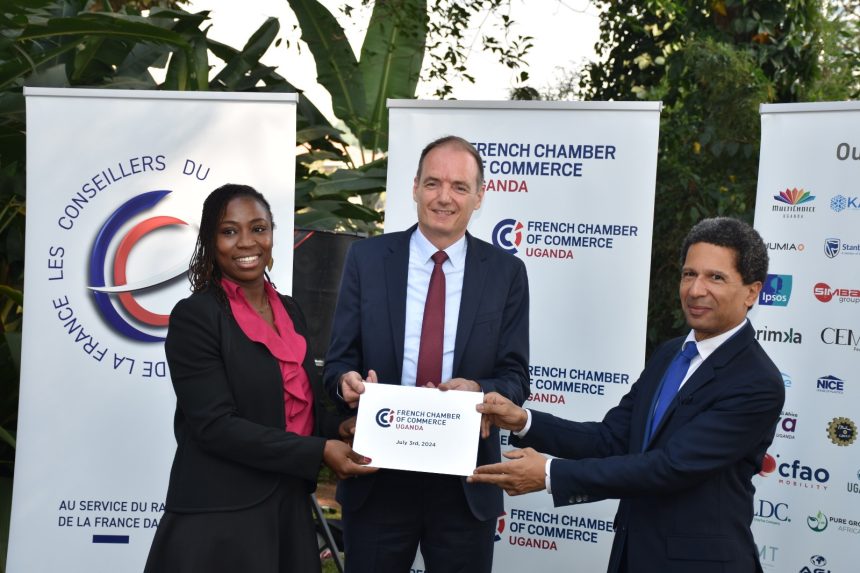
The Embassy of France has launched the French Chamber of Commerce with a view to increase the Uganda-French investment and trade.
The move is anticipated to generate over 4 billion dollars’ worth of Foreign Direct Investments over the next 3 years.
According to the Ambassador of France to Uganda, H.E. Xavier Sticker, the chamber will ensure Ugandan companies achieve French exposure.
While presenting positive trends in the development of the economic relations between France and Uganda, it was revealed that from just 9 in 2010, there are now 40 French companies in Uganda.
In 2023, they generated sales of up to USD 875 million and employed more than 3000 Ugandans,30% of whom are women. In 2022 and 2023 their investments doubled to reach USD 1.6 billion or 53% of FDI inflows into Uganda.
The President of the French Foreign Trade Advisory Committee, Jean Gavalda, notes that they aim to promote networking which will pave way for deeper and stronger bilateral economic relations.
This is on the back of Uganda’s political stability and investor friendly legislation which has enabled French companies to operate successfully while taking advantage of numerous market opportunities, in the emerging economy.
President of the French Chamber of Commerce, Thomas Pelletier says French Companies are the leading investors in the country and are active in almost every area of the economy including agriculture, energy, distribution, logistics, new digital technologies, and electric mobility.
In the renewable solar energy sector,3 companies account for 25% of Uganda’s solar power capacity, providing green energy to more than 120,000 homes while in regard to investing in human capital,in 2023,they offered more 46,000 hours of training to their employees and financed study grants for young Ugandans.
France is the first country in the European Union to set up a chamber of commerce in Uganda and the number of French companies has tripled in a space of 15 years, structured around a business club (Club d’Affaires de Kampala-CAK) that was created in 2017.
Now with a membership of 63, half of whom are Ugandan companies, the club has been integrated into the International Network of Chambers of Commerce and Industry (CCI).
…………………
Lion breeding was misunderstood,UWEC
The Uganda Wildlife Conservation Centre (UWEC) says the public misunderstood them and received unjust criticism over the proposal to spend Shs 10 Billion on the breeding of lions.
David Musingo, Head, Lion Recovery Programme, at UWEC, while appearing before Parliament’s Committee of Commissions, Statutory Authorities and State Enterprises (COSASE), says their concept was misconceived by the public, because the money would also be spent on policing the cubs and sensitizing the communities around the national parks, on the dangers of poaching lions.
This while responding to questions from MPs on what strategies are being put in place to increase the population of lions in Uganda.
However, the Chairperson of the committee, Medard Sseggona (Busiro East) is blaming the Entebbe Zoo for not clearly explaining what the lion breeding program would entail, saying had their concept been clearly articulated, Ugandans would have understood the rationale of the lion breeding program and there wouldn’t have been backlash over the proposal.
“What is wrong with breeding lions? The problem is that you are scared because you can’t explain. If I tell someone we are going to breed lions and I explain the purpose, for those who probably don’t understand, when you go to those national parks, actually the rarest animals to be seen are lions.”
“If you want to see them, you have to wake up at a particular time and you drive 100 Kms and they appear at a particular place. I mean, I have come to rest, you want me to wake up at 4am simply because animals are few. Why would you feel sorry to say you want to breed lions? That you feel bashed, that isn’t a problem,” Ssegona adds.
UWEC attributes the drop in lion population to human wildlife conflict, where residents snare other animals like Kobs and antelopes, but the lions end up falling victim to the traps as well as a disease outbreak that occurred in Kidepo that claimed many lions.
“But also, what is challenging about Kidepo National Park is that it is in neighboring countries like South Sudan. So, when these animals cross to neighboring countries like South Sudan where there is no order, they are killed,” adds Musingo.