



Africa is home to nearly 20 percent of the world’s population, yet it accounts for less than 1 percent of global data center capacity.
For AI investors and technology strategists, that imbalance is not just a statistic — it is a structural constraint with long-term economic consequences.
To understand the scale of the gap, consider this: a single county in Northern Virginia in the United States hosts roughly three times the data center power of the entire African continent combined. That comparison reframes Africa’s digital conversation from one of connectivity to one of compute power.
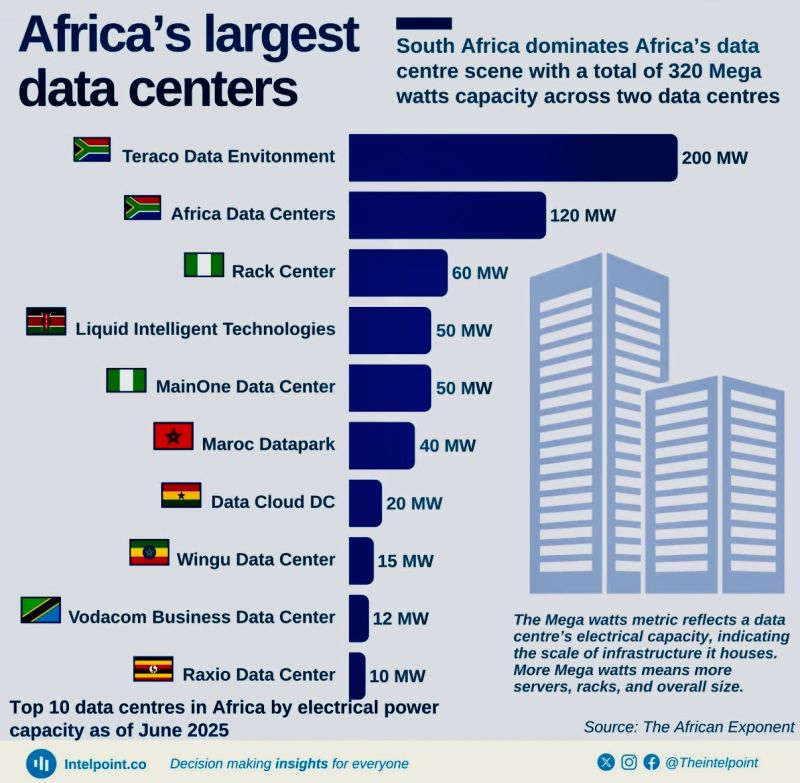
A handful of companies are currently carrying the continent’s digital infrastructure ambitions. Teraco, a Digital Realty company based in South Africa, leads with a footprint of about 181 megawatts (MW).
Africa Data Centres follows with around 139 MW across multiple markets. Vantage Data Centers and MainOne contribute roughly 80 MW combined, strengthening hyperscale capacity in South Africa and Nigeria. These are significant investments, but they remain small when viewed against global benchmarks.
South Africa, the continent’s leader in capacity, operates at a scale comparable to a mid-sized European city such as Madrid. That reality shows how early Africa still is in building foundational infrastructure for the AI economy.
The implications go beyond faster internet speeds. Without local compute infrastructure, Africa cannot train sovereign AI systems at scale. Data sovereignty becomes theoretical when the processing power sits offshore.
Startups building AI solutions often rely on foreign cloud providers, meaning capital flows outward to fund infrastructure in Europe or North America. This creates economic leakage at precisely the moment the continent is seeking digital self-determination.
Energy adds another layer of complexity. Data centers are power-intensive. The combined 320 MW capacity of the top two players alone rivals the total electricity generation of some smaller African countries. Infrastructure expansion must therefore align with energy investment, or growth will hit a hard ceiling.
Yet momentum is building. The African data center market is expanding at an estimated 24 percent annually, making it one of the fastest-growing globally. New entrants and regional operators are scaling, and global hyperscalers are increasingly evaluating African markets.
For investors, this is not merely an infrastructure story. It is a foundational layer of the AI economy.
The continent’s digital future will depend not just on connectivity, but on whether Africa can host, process, and train its own data.