


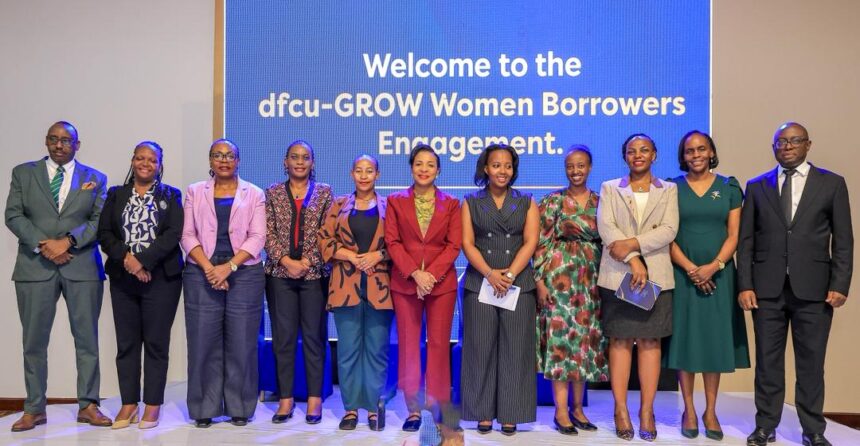
Uganda is banking on women-owned businesses to become a larger engine of jobs and private-sector growth, with more than UGX160 billion already channelled to over 10,000 women entrepreneurs under a government-backed financing programme.
The scale-up is being driven through the Generating Growth Opportunities and Productivity for Women Enterprises (GROW) Project, which aims to reach 60,000 women-owned enterprises by December 2027.
dfcu Bank, one of the participating financial institutions, has so far disbursed more than UGX24.2 billion to 496 women-owned businesses, providing financing for productive assets and expansion across agriculture, trade, manufacturing, education and business services.
The figures highlight both the size of the opportunity and the challenge facing Uganda’s financial sector, which is, converting small women-led enterprises into sustainable, productive businesses capable of borrowing, hiring and expanding.
Margaret Karume, dfcu’s Executive Director and Chief Credit Officer, urged beneficiaries to treat their enterprises as employers rather than simply sources of household income, while stressing proper financial records and separation of business and personal finances.
Stronger financial discipline could translate into a deeper pipeline of bankable businesses and repeat borrowers, while a successful scaling of women-owned enterprises could broaden employment,household incomes and strengthening domestic production.
The World Bank-funded programme combines financing with business development services, mentorship, training and market linkages, reflecting a shift from credit-only interventions toward building enterprises capable of surviving beyond subsidised financing.
GROW National Coordinator John Ssengendo also called on lenders to consider productive movable assets including machinery, equipment and inventory as collateral, potentially widening access for entrepreneurs without substantial fixed property.
PSFU Chief Executive Officer Stephen Asiimwe said sound record-keeping and financial management would remain critical for businesses seeking additional financing.