


By Muhumuza Edwin
Uganda is shifting its statistical priorities from addressing data shortages to improving how government institutions use information to guide public spending, economic planning and service delivery, with the government warning against the manipulation of figures to justify development programmes.
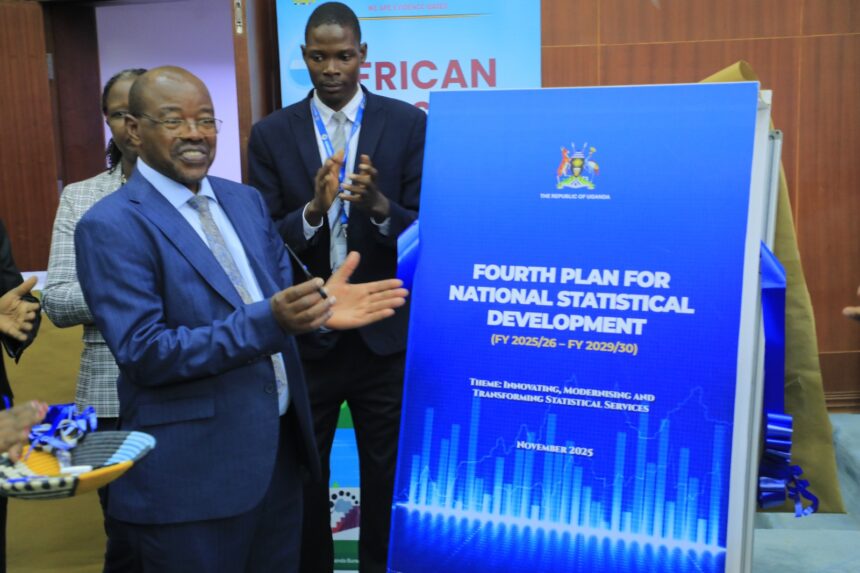
The warning was issued by State Minister for Finance and Planning Amos Lugoloobi during the launch of three strategic documents by the Uganda Bureau of Statistics (UBOS), as the country seeks to strengthen evidence-based decision-making in pursuit of its tenfold economic growth ambition.
The documents include the Fourth Plan for National Statistical Development (PNSD IV), UBOS Strategic Plan IV and the UBOS Service Delivery Standards.
Lugoloobi said Uganda has made considerable progress in generating official statistics, but their utilisation in policy formulation, budgeting and monitoring government programmes remains a challenge.
He recalled that during the formulation of the country’s first National Development Plan, government planners struggled to obtain baseline information across sectors, frequently relying on estimates and information from external sources.
The situation has since improved, with ministries, departments and agencies increasingly generating administrative data. However, the minister said the focus must now shift towards ensuring that the information informs actual government decisions.
“Statistical data is important to help generate a plan such as this for development to enable government work accordingly,” Lugoloobi said.
He also cautioned against the deliberate manipulation of statistics to justify public interventions that may not reflect the actual needs of communities.
“At times people use figures to obtain their own interests deceptively. Eg someone says, ‘we are going to serve 5k people yet the area has a few people. We need to have the right figures for what we are going to do,” he said.
The warning raises questions about the reliability of information used to determine beneficiaries, allocate public resources and assess the performance of government programmes.
UBOS Executive Director Dr Chris Mukiza said the new strategic documents are aligned with the Fourth National Development Plan and are intended to strengthen the production of quality official statistics for national planning, monitoring and evaluation.
“The Board takes great pride in overseeing the production of quality official statistics that support evidence-based planning, monitoring and evaluation of government programmes,” Mukiza said.
He said statistics should be regarded not merely as a technical requirement for policymakers but as a strategic national asset that enables informed decisions and supports national transformation.
The new Service Delivery Standards are also intended to improve the bureau’s accountability and responsiveness to users of statistical information.
UBOS Principal Officer Ivan Kanyeheyo said the standards establish benchmarks for serving researchers, government agencies, businesses and members of the public. They also provide procedures for requesting information, seeking clarification and submitting feedback, with the bureau expected to respond within specified timelines.
The standards are expected to be reviewed every five years, or earlier where necessary, to accommodate technological developments and changing information needs.
UBOS is also expanding digital access to official statistics through its online platforms.
The bureau’s Head of Digital Solutions, Ivan Atwiine, said members of the public can access statistical information through the data dissemination portal on the UBOS website, www.ubos.org, under the Data Portals section.
The digital expansion complements Lugoloobi’s call for government institutions to embrace artificial intelligence, big data analytics and improved data integration to make official statistics more accessible and useful.