


By Steven Ainganiza Waddel
FORT PORTAL — Fort Portal Regional Hospital is set to recruit 145 critical staff this financial year in a major staffing expansion aimed at addressing shortages and improving healthcare delivery to millions of people in the Tooro and Rwenzori sub-regions.
The planned recruitment will target senior critical staff, including specialists and nurses, as the referral hospital seeks to strengthen its capacity to handle the growing demand for healthcare services. The hospital serves more than three million people across nine districts in the two sub-regions and also receives patients from parts of the Democratic Republic of Congo.
The hospital currently handles more than 300 outpatient visits every day and records between 1,350 and 1,780 admissions each month, depending on the season. However, its ability to provide timely and quality services has been constrained by staffing gaps across several departments.
Dr Bahizi Archbald Newton Sebahire, Senior Executive Consultant and Director of Fort Portal Regional Hospital, said the recruitment plan has already been submitted to the Ministry of Public Service and that the job advertisement is expected soon.
“We have already submitted our recruitment plan to the Public Service Ministry, and the advertisement is forthcoming,” Dr Bahizi said. He added that recruiting 145 critical staff, including senior specialists and nurses, would help bridge existing gaps and improve the quality and timeliness of care.
The extent of the shortage varies across departments, with some units operating with only a fraction of the staff required.
“In some areas, we should have ten staff members, but we only have one or two,” Dr Bahizi said. “This disparity causes delays in service delivery and affects the overall patient experience.”
He said strengthening the workforce is particularly important for emergency and specialised services, where delays in intervention can have serious consequences for patients.
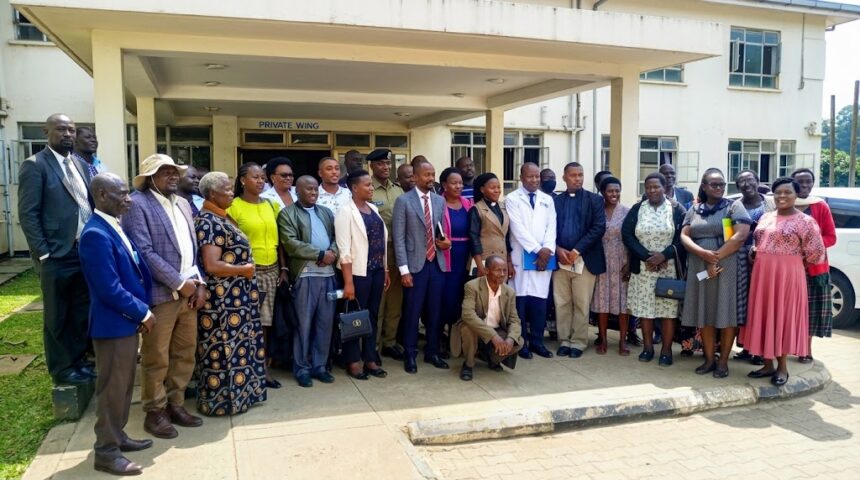
The recruitment plan was announced during a community dialogue, or Baraza, held at the hospital’s boardroom to give members of the public and key stakeholders an opportunity to assess the hospital’s performance, learn about new services and identify areas requiring improvement.
The engagement brought together Village Health Teams, religious leaders, civil society organisations, district and city officials, cultural leaders, heads of Health Centre IVs and hospital staff.
Participants were also taken on a tour of several hospital facilities, including the casualty ward, outpatient department, oxygen plant, mortuary, surveillance system and the hospital’s high-tech satellite laboratory.
One of the major developments highlighted during the engagement was the hospital’s diagnostic capacity. Its satellite laboratory provides a range of tests, including malaria, PCR, Ebola and COVID-19 testing, reducing the need for patients in the region to travel to Kampala or Mbarara or seek more expensive private alternatives.
The hospital has also expanded access to advanced diagnostic services, including CT scans, kidney diagnostics and DNA testing.
Despite these developments, participants said public awareness remains a major challenge, with many residents still unaware that the services are available at Fort Portal Regional Hospital.
Rev Sarah Kakyo, the Rwenzori Diocesan Health Coordinator, welcomed the technological improvements but called for greater community sensitisation.
“While we are proud of these state-of-the-art services, many people in the region are unaware of what is available. We must do more to inform and educate the community so that they can benefit from these life-saving diagnostics,” she said.
The community dialogue also provided an opportunity to reflect on changes at the hospital in recent years.
Margaret Kihika, Secretary for Finance, Planning and Administration at Fort Portal Tourism City, who represented the mayor, described the Baraza as an important platform for improving transparency and cooperation between the hospital and the community.
She recalled a period when community leaders protested over concerns about service delivery and hospital management, saying the situation had since improved.
“Today, we celebrate the improvements—better services, infrastructural upgrades, and the empowerment of Health Centre IVs to handle emergency procedures like obstetric surgeries, which will help decongest the referral hospital,” Kihika said.
Mr Businge Emmanuel, Deputy Fort Portal City Resident Commissioner, also credited the hospital’s new leadership with contributing to improvements at the facility.
“There has been remarkable progress since the new leadership took over,” Businge said, urging stakeholders to continue supporting the hospital and encouraging members of the public to make use of its services.
Local leaders further praised improvements in infrastructure, cleanliness and the adoption of modern healthcare practices.
Dr Emma Mugisa, the City Health Officer, particularly highlighted the hospital’s efforts to strengthen lower-level health facilities to perform obstetric surgeries.
She said the development could contribute to reducing maternal deaths by allowing women requiring surgical intervention to receive timely care closer to their communities instead of relying entirely on the regional referral hospital.
“Our goal is to eliminate maternal deaths and improve health outcomes across the region, and with these innovations and a stronger workforce, I am confident we are on the right path,” Dr Mugisa said.
The planned recruitment of 145 staff therefore comes at a critical time for Fort Portal Regional Hospital as it seeks to match its workforce with increasing demand for healthcare services.
For a facility serving millions of people and functioning as a referral centre for the wider Tooro and Rwenzori region, addressing staffing shortages could improve waiting times, strengthen specialised services and enable health workers to respond more effectively to emergencies.
Combined with investment in diagnostics, infrastructure, lower-level health facilities and community engagement, the recruitment drive marks an important step in the hospital’s efforts to improve healthcare delivery.
The challenge now will be ensuring that the planned positions are filled and that the additional workforce is matched with the equipment, infrastructure and resources required to deliver the level of care expected by the communities the hospital serves.