


Uganda is seeking to reduce its dependence on foreign financing by mobilising domestic savings, reforming the pension sector and expanding private investment, as government rethinks how to fund its ambition of growing the economy tenfold by 2040.
The proposed changes include deepening capital markets, strengthening development finance institutions, expanding public-private partnerships (PPPs) and encouraging banks and insurers to take a more active role in financing productive enterprises.
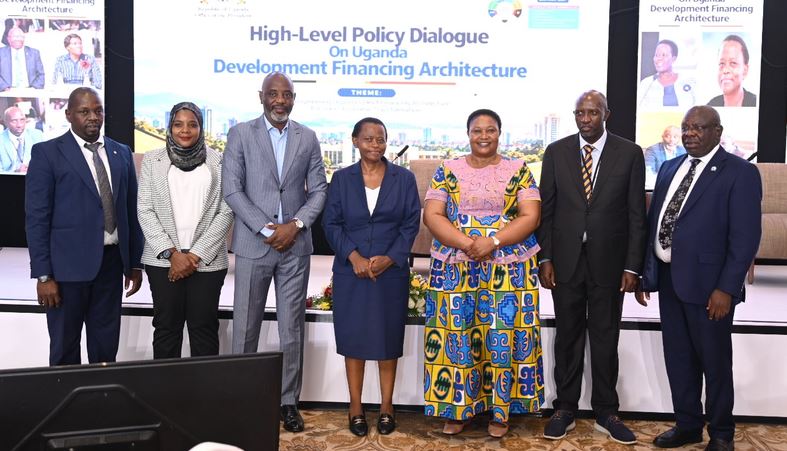
This was during a high-level dialogue on Milly Babalanda, Joseph Muvawala, architecture, where the Minister of the Presidency, Milly Babalanda, Joseph Muvawala, Executive Director of the National Planning Authority (NPA), and Vincent Bamugaya, Director in the Office of the President and head of the Apex Platform, and others discussed the financing constraints that could determine whether the country achieves its long-term economic ambitions.
Key in their remarks was that Uganda needs substantially more long-term capital to finance investment, create jobs and expand production, while traditional concessional financing becomes less available and the cost of borrowing rises.
Muvawala argued that faster economic growth is essential not only to meet rising development needs but also to improve the sustainability of public debt.
“Many Ugandans think that this is a slogan, but for us we think this is survival,” he said, referring to the tenfold growth ambition.
He pointed to population growth of 3.2% and inflation approaching 4%, arguing that economic growth of around 6% could prove insufficient to meet the country’s expanding needs.
“If we are going to grow at the same pace, then our debt to GDP ratio will start moving out. But if we grow faster, for example 10%, you are going to see that our debt to GDP ratio will go down,” Muvawala said.
His argument places economic growth at the centre of Uganda’s financing strategy: a larger, more productive economy can generate more revenue and investment, helping to ease pressure on public finances.
Pension reform seen as source of long-term capital
A major priority is reforming Uganda’s pension sector to unlock more long-term financing for infrastructure, businesses and government investment.
Muvawala said Uganda’s financial system relies on a relatively narrow pool of capital, limiting the government’s ability to borrow at sustainable rates and finance projects whose returns take years to materialise.
“The problem is that we are borrowing from a narrow market,” he said, calling for pension reforms that would increase the supply of long-term funds and deepen the domestic bond market.
He warned against using short-term capital to finance long-term investments because repayment obligations can arise before projects generate sufficient returns.
The NPA executive director also identified Islamic finance, securitisation and public-private partnerships as potential sources of additional capital, while acknowledging that PPP projects face institutional delays, capacity constraints and difficulties in project preparation.
For Muvawala, however, the bigger opportunity lies in mobilising money already circulating within Uganda.
“All the monies for our development in this architecture must come from us, Ugandans,” he said.
He argued that Uganda must broaden its tax base and progressively increase its tax-to-GDP ratio towards 25%, alongside efforts to mobilise savings through pension funds and other domestic investment channels.
Private sector financing must go beyond government spending
Bamugaya said the dialogue was intended to identify practical changes that would enable government institutions and the private sector to support the tenfold growth strategy more effectively.
He argued that achieving the 2040 ambition would require public servants to rethink existing practices rather than simply repeat the growth target.
“What we are doing here is basically to discuss and look at how we are and how we are prepared to actualize that tenfold growth rather than just singing it or remaining with it as a dream,” Bamugaya said.
He said the country’s existing financing architecture was not fundamentally broken but needed to be re-engineered to match Uganda’s development ambitions.
Bamugaya also called for financial instruments that would encourage ordinary Ugandans to invest their savings in productive economic activities rather than confining their investments to assets such as land and livestock.
He said domestic financing offers an important advantage because interest payments and investment returns can remain within the local economy, supporting further economic activity.
“Depending on external financing is no longer sustainable,” he said, emphasising the need to bring more domestic investors into national development financing.
Regulatory barriers threaten enterprise growth
Muvawala also turned attention to the challenges facing small businesses, particularly young entrepreneurs who struggle to access finance and comply with regulatory requirements.
He urged government agencies to support emerging enterprises as they improve their standards instead of shutting them down for failing to meet requirements at the outset.
“If somebody has started an investment, it’s not going to start from high quality. They are going to start from low quality,” he said.
He called for institutions such as the Uganda National Bureau of Standards to help businesses improve their products and operations, arguing that regulatory support could help young entrepreneurs grow into formal, productive enterprises.
Banks also came under scrutiny for what Muvawala described as excessive risk aversion, which he said makes borrowing difficult and pushes some entrepreneurs towards moneylenders.
He called for discussion of the regulatory environment governing banks’ non-performing loans, arguing that lenders need sufficient room to finance viable but riskier businesses.
He also urged insurers to expand coverage beyond individual assets to entire value chains, helping businesses manage investment risks more effectively.
The broader policy challenge, according to the dialogue is to coordinate domestic savings, private investment, development finance and international partnerships within a financing framework aligned with Uganda’s national priorities.
The government intends to explore opportunities involving pension and insurance funds, green and climate finance, blended finance and other long-term investment instruments.
The underlying test, however, is whether the additional capital translates into higher productivity, value addition, exports, employment and household incomes.