


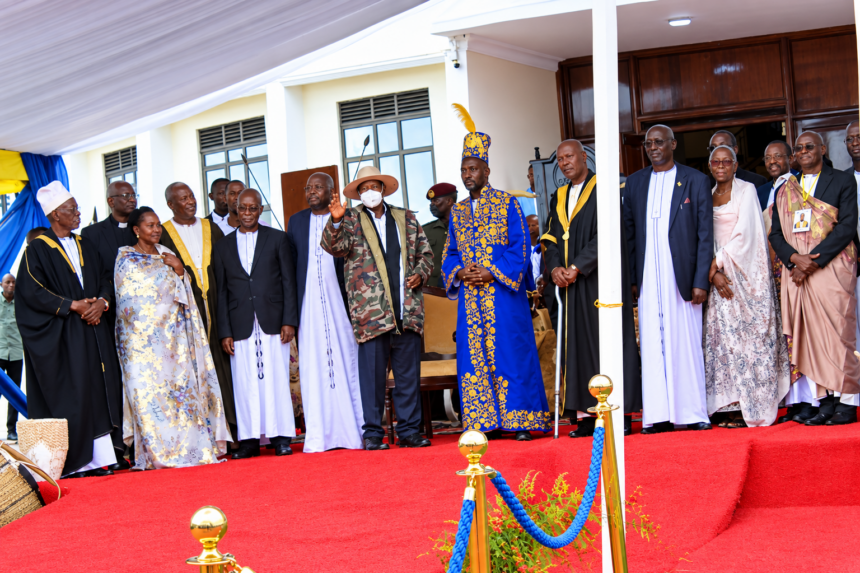
The coronation of Prince Edward Rukidi Nyabongo I as Tooro’s new king was more than a royal ceremony.
Behind the pomp, cultural rituals and succession speeches, President Yoweri Kaguta Museveni delivered a series of messages touching on indigenous knowledge, plastics, cancer, language, marriage, HIV, poverty and the political neutrality of cultural institutions.
Some of the most significant moments came outside the formalities of the enthronement.
Speaking at the royal palace in Harukoto, Fort Portal City, Museveni urged cultural leaders to become custodians of indigenous knowledge and customs, arguing that kingdoms could play a bigger role in addressing some of Uganda’s social and economic challenges.
One of his more unusual appeals was for cultural leaders to promote traditional wooden and clay utensils as alternatives to plastics.
“Cultural leaders should be the patrons of indigenous science and promote the wooden utensils that are not poisonous to our health,” Museveni said.
The president linked his argument to concerns about health and cancer, saying some modern products, including plastics, could have harmful effects.
Museveni also placed language preservation at the centre of the role of cultural institutions.
He said Uganda’s modern education system had neglected indigenous languages and urged cultural leaders to take responsibility for keeping local languages, customs and values alive.
“The modern systems have neglected language,” he said.
He pointed to Kenya and Tanzania, where Kiswahili has a stronger presence in the education system, and said Uganda’s cultural institutions could help reverse the decline of indigenous languages.
Museveni also revealed that he had given the new king a copy of his Runyankore dictionary, Katondogorozi, which he said could help him teach cultural customs and values.
The message on marriage that drew attention
The president went beyond language and culture to address marriage and family relationships.
He urged cultural and religious leaders to educate young people about clan identities and traditional values and called for greater attention to family backgrounds before marriages are conducted.
He specifically warned against marriage between members of the same clan, citing the Babiito as an example.
“The Babiito should not marry each other; this is a taboo,” Museveni said.
He also connected cultural leadership to public health, pointing to HIV prevalence in parts of southwestern Uganda and calling for greater community mobilisation to address risky sexual behaviour.
Museveni’s wealth-creation message
The president also used the royal gathering to return to one of his longstanding economic messages—household wealth creation.
He urged cultural leaders to encourage their communities to participate in government programmes aimed at increasing household incomes.
“I am glad that some Ugandans have listened to my advice on wealth creation and the four-acre model, and are now earning millions,” he said.
For the new Tooro administration, that could become one of the most important tests of its relevance: whether the kingdom can use its cultural influence to mobilise communities around education, enterprise, agriculture and other development programmes.
The new king’s first promises
In his first major address as king, Edward Rukidi Nyabongo I struck a conciliatory tone, stressing that the kingdom belongs to the people of Tooro.
Using the local saying, “Ageteraine nugo gaita igufaa,” he emphasised the importance of working together.
The king pledged to work with residents, elders and religious leaders to improve education, promote wealth-creation programmes and preserve Tooro’s customs and values.
He also promised that the palace would remain open to everyone.
“It is the responsibility of the kingdom to preserve cultural customs, norms and the dignity of the institution, and to guard against politics and misleading the people,” he said.
That commitment to keeping the kingdom separate from partisan politics echoed one of Museveni’s central messages during the ceremony.
The environmental agenda
Another issue that could define the new reign is the environment.
King Edward pledged to support conservation and protect wetlands from destruction, adding an environmental dimension to his development agenda.
His accession also comes at a time when Tooro is seeking to position itself around tourism, agriculture, environmental conservation and investment.
The king is expected to tour the kingdom’s counties and mobilise residents around wealth creation, education, food security, tree planting, environmental protection and HIV prevention.
He is also expected to pursue scholarships for disadvantaged but academically outstanding students, promote health and attract development partners and investment into Tooro.
A tribute to King Oyo
The coronation was inevitably marked by memories of the late King Oyo Nyimba Kabamba Iguru IV, who died of cancer in the United States on August 27, 2026.
Museveni recalled receiving a letter from Oyo dated June 15, 2026, thanking him for supporting the kingdom, including through the appointment of a minister from the Tooro region.
The president said he discovered the letter a day after Oyo’s burial.
Museveni also praised Oyo’s contribution to the fight against HIV/AIDS and recalled supporting the former king from his installation as a young monarch through his education, leadership development and medical treatment abroad.
The government donated 100 head of cattle to the kingdom during the coronation.
A kingdom enters a new chapter
The succession process was also acknowledged by Minister for Gender, Labour and Social Development Gen. Henry Tumukunde, who thanked Museveni for his guidance and praised Queen Mother Best Kemigisa and Musuga Charles Kamurasi for their roles in maintaining stability.
Tumukunde called for a review of laws governing cultural institutions, warning that unresolved conflicts could threaten their stability.
Kamurasi, head of the Ababiito clan, formally handed the kingship to Edward Rukidi Nyabongo I.
His emotional tribute to Oyo highlighted the late king’s international work on HIV/AIDS and the role he played in putting Tooro on the global map.
The new king now inherits an institution balancing tradition with the demands of modern development.
Beyond the coronation ceremonies, his reign will be tested by whether the palace can turn its influence over culture and identity into practical action on education, household incomes, health, environmental protection and investment—while maintaining the political neutrality that both the president and the new king emphasised.