



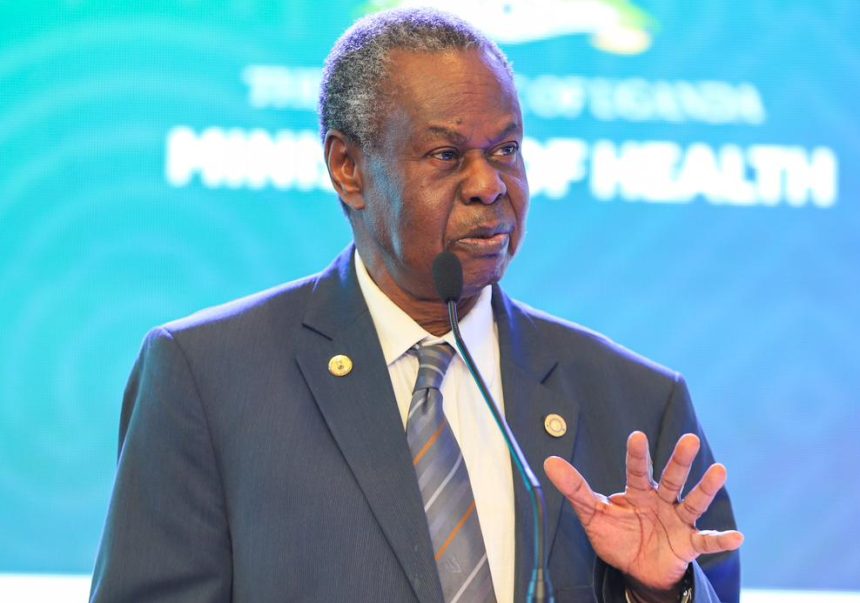
Professor Francis Omaswa, Executive Director, African Center for Global Health and Social Transformation has called on Ugandan and African health leaders to take personal responsibility in transforming the continent’s health systems, stressing that progress in combating both communicable and non-communicable diseases (NCDs) will only come through local leadership and collective accountability.
Delivering his keynote speech at the Joint Annual Scientific Health (JASH) Conference and the 1st National Annual Communicable and Non-Communicable Diseases Conference (NACNDC), Prof. Omaswa said that Africa must stop depending on external actors to fix its health challenges and instead lead its own solutions.
“At a recent regional forum in Kigali, we began by blaming donors, but the discussion quickly turned to blaming ourselves,” he said. “Why do we expect others to solve our problems? It is up to us to achieve our health goals—and we can, if each one of us commits to doing our part diligently.”
Prof. Omaswa, the Executive Director of the African Centre for Global Health and Social Transformation (ACHEST), emphasised the need for inclusive leadership, teamwork, and community engagement in tackling health burdens.
He urged health professionals to emulate Uganda’s successful response to HIV/AIDS in the 1990s, when collective mobilisation and strong political leadership reduced national prevalence rates from 18% to about 6%.
“We must rekindle that same whole-of-society and whole-of-government approach,” he said. “Everyone—from local leaders to ministries of finance, education, and communication—must be part of the response.”
Omaswa further stressed the critical role of data and technology in modern health governance. He welcomed the Ministry of Health’s recent efforts to establish a unit focusing on data and artificial intelligence, noting that evidence-based strategies are key to fighting diseases like hypertension, diabetes, and stroke.
“The world is moving fast toward using data and AI. We must generate and share reliable information so that our communities understand the risks and solutions,” he urged.
Drawing lessons from Uganda’s COVID-19 response, where village-level task forces mobilised communities effectively, Omaswa said similar community engagement mechanisms should be applied in addressing NCDs and other health priorities.
He also highlighted the demographic urgency of focusing on Uganda’s youthful population—over 70% of whom are below 30 years—stating that national health strategies must be designed to resonate with the young and actively involve them.
Turning to the economics of health, Prof. Omaswa dismissed the outdated notion that health is a “consumptive” sector. He cited global research showing that investment in health drives economic growth, employment, and productivity.
“Without health, wealth is nothing,” he said. “Health is a major contributor to economic development. Look at Germany—about 30% of its economy is linked to health through manufacturing, trade, and employment.”
He called on policymakers to frame health spending as a development investment rather than an expense, noting that the public already prioritises health, as seen in their electoral demands for better facilities.
Prof. Omaswa concluded by urging all health leaders to lead by example: “Each of us must go back and be the leader we are meant to be. Let no one go to sleep—Uganda knows what to do; we just need to do it.”