



Uganda’s push to transform agriculture from subsistence production into a competitive agribusiness sector is increasingly being driven by an unusual strategy: exporting farmers to learn from one of the world’s most productive agricultural economies.
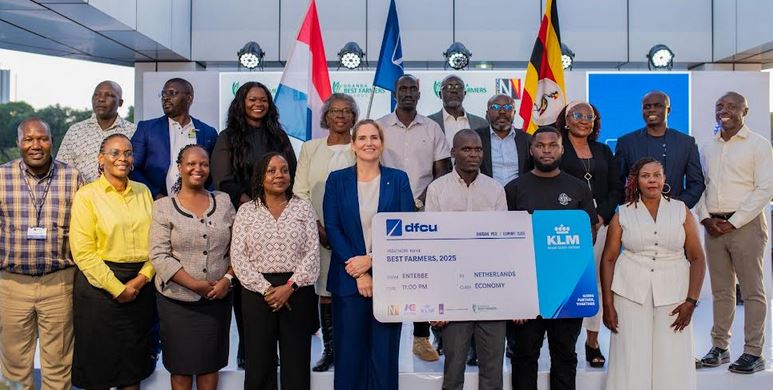
This week, 13 winners of the 2025 Best Farmers Competition were flagged off to the Netherlands for a one-week study tour aimed at exposing them to advanced farming technologies, value-addition systems and cooperative business models that have made the European nation the world’s second-largest agricultural exporter by value despite its small land size.
The initiative, spearheaded by dfcu Bank in partnership with the Embassy of the Netherlands, KLM Royal Dutch Airlines, De Heus Koudijs Nutrition BV, Vision Group and the New Vision Foundation, comes at a time when Uganda continues to grapple with low agricultural productivity, limited mechanisation and weak access to global markets.
The selected farmers, drawn from enterprises ranging from coffee and livestock to poultry and cooperative farming, will spend a week studying modern agricultural systems and exploring commercial partnerships that could be replicated back home.
While study tours are often dismissed as symbolic rewards, the programme’s backers argue that international exposure has become a critical tool in addressing knowledge gaps that continue to constrain Uganda’s agricultural sector.
According to dfcu Bank, more than 134 farmers have been recognised under the programme since its inception 12 years ago, with all winners receiving opportunities for training, financing and international exposure. The bank says over 1,200 agribusinesses have also been supported through its agricultural programmes, indirectly benefiting more than 59,000 people across the country.
The Netherlands’ commitment to Uganda’s agricultural transformation extends beyond knowledge exchange.
Dutch Ambassador Frederieke Quispel revealed that the Netherlands invests approximately €80 million approximately UGX 344 billion, annually in Uganda’s agricultural sector, focusing on value-chain development, technology transfer and market access.
The significance of the partnership is reflected in growing trade ties between the two countries, particularly in livestock genetics, seeds and agricultural inputs. Industry observers note that Uganda’s agricultural exports remain largely raw commodities, making value addition one of the biggest untapped opportunities for farmers.
The programme also highlights a broader shift in agricultural financing. In the first quarter of this year alone, dfcu disbursed UGX 58 billion to 136 farmers and agribusinesses, offering loans at rates as low as 12 percent annually. Through insurance-backed lending models, farmers are increasingly being encouraged to view agriculture as a business rather than a livelihood activity.
The bigger question, however, is whether lessons learned abroad can be successfully adapted to Uganda’s realities.
For the 13 farmers boarding flights to Amsterdam, the answer could determine whether exposure translates into productivity—or remains another well-intentioned agricultural experiment.