


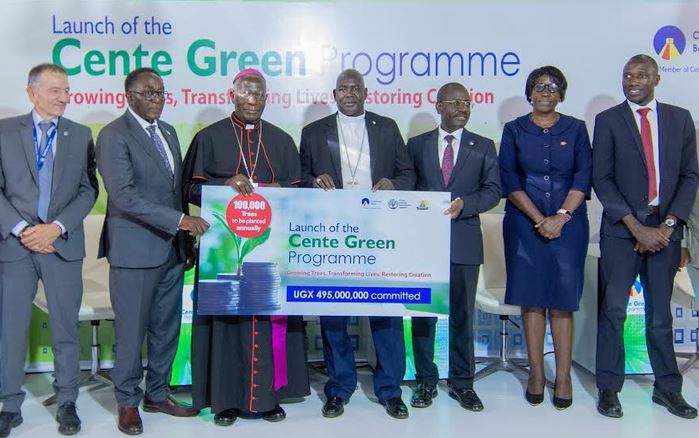
Centenary Bank has committed UGX495 million to support the growing of 500,000 indigenous timber and fruit trees across Uganda by 2030, as the lender makes environmental sustainability part of its long-term business strategy.
The five-year initiative, dubbed Cente Green Days, will support the growth of 100,000 trees annually and restore about 1,500 acres of degraded land across Uganda.
Launched under the theme “Growing Trees, Transforming Lives, Restoring Creation,” the programme is being implemented in partnership with the Uganda Episcopal Conference and Good Forests Foundation, with 12 dioceses already participating.
Centenary Bank Managing Director Godfrey Byekwaso said the initiative forms part of the bank’s Environmental, Social and Governance agenda and reflects the connection between financial services, businesses, communities and the environment.
“At Centenary Bank, we are a values-based Bank that recognises the critical connection between financial services, businesses, communities and the environment in which they operate,” Byekwaso said.
He said environmental restoration is critical for Uganda because more than 70% of the country’s economy depends on agriculture, leaving communities and businesses vulnerable to irregular rainfall, prolonged drought and floods.
The programme will initially support the restoration of approximately 300 acres across 12 districts this year, before expanding to about 1,500 acres over five years.
The bank’s latest commitment builds on its existing environmental efforts. Since 2023, Centenary Bank has supported the growing of more than 250,000 trees across the country.
The lender also plans to mobilise its 3,500 employees and 3.4 million customers to participate in tree growing, with 77% of its branch network located in rural areas.
Byekwaso said the programme will provide communities with practical economic benefits, including improved food security, diversified household incomes and greater resilience against erosion, floods and drought.
Good Forests Foundation will provide technical expertise in site assessment, species selection, planting, maintenance and monitoring, while the Uganda Episcopal Conference will help mobilise communities through its extensive network.
The bank began measuring its carbon emissions in 2025, recording more than 6,000 tonnes of carbon dioxide equivalent. Tree growing will form part of its broader efforts to contribute to carbon sequestration and manage its environmental footprint.
Byekwaso has called on other organisations to contribute resources, expertise and community networks to expand the initiative beyond its initial five-year target, saying tree growing should become a shared national responsibility.