



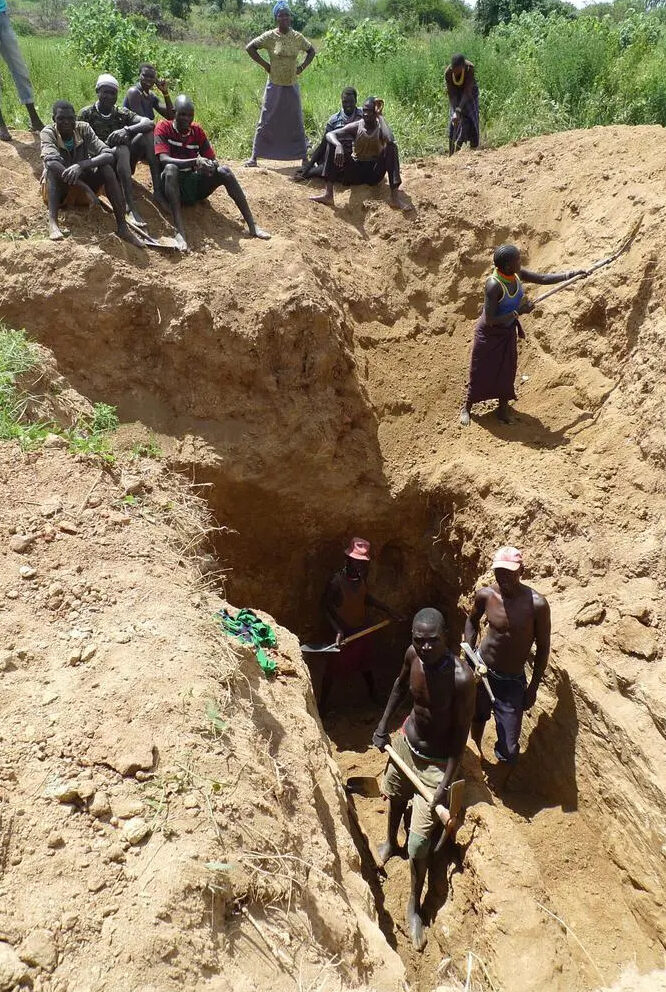
Uganda’s artisanal and small-scale mining (ASM) sector is set for a structural overhaul following the launch of the Training, Equipping and Nurturing to Thrive (TENT) grant, a targeted intervention backed by the European Union and German government to formalise one of the country’s most under-leveraged economic segments.
The 12-month initiative, implemented by the Uganda Chamber of Energy and Minerals in partnership with GIZ Uganda under the supervision of the Ministry of Energy and Mineral Development, will run from November 2025 to October 2026 across 10 districts in five mining regions.
The programme targets the formalisation of at least 20 artisanal mining cooperatives in districts including Mubende, Kasanda, Moroto, Busia and Kisoro, covering key mineral value chains such as gold, tin, tungsten (3Ts), iron ore and marble. These cooperatives are expected to serve as anchor entities for scaling sector reforms.

Humphrey Asiimwe, Chief Executive Officer of UCEM, said the initiative is designed to transform artisanal mining from fragmented informal activity into a coordinated and investable sector.
“We are organising artisanal miners into cooperatives that can access financial services, attract investment and engage directly with off-takers in formal markets,” Asiimwe said. “This is about building a scalable model that can be replicated across the country to unlock value in the mining sector.”
Uganda’s ASM segment currently accounts for more than 90% of national mineral production and supports an estimated 200,000 direct livelihoods, with women comprising nearly 50% of the workforce. However, fewer than 20% of operators are formally licensed—effectively excluding the majority from formal credit markets, regulated supply chains and government revenue systems.
The TENT grant is designed to close this gap through four strategic pillars: formalisation and compliance, policy and knowledge development, market access, and institutional sustainability. Beyond the initial 20 cooperatives, the initiative has a medium-term ambition of formalising up to 100,000 artisanal miners and establishing at least 50 model cooperative enterprises by 2030.
From an economic standpoint, the upside is substantial. The ASM sector currently contributes an estimated 0.5% to Uganda’s GDP despite dominating production volumes. With improved traceability, taxation and value chain integration, stakeholders project this contribution could exceed 3% within five years—a sixfold increase driven largely by formal market participation and reduced leakages.
A key constraint the initiative seeks to address is access to finance. Participating financial institutions have already indicated willingness to provide credit facilities and banking services to the targeted cooperatives, a move expected to de-risk the sector and catalyse capital inflows. Structuring miners into cooperatives also reduces transaction costs for lenders and regulators, compared to dealing with thousands of individual operators.
David Ssebagala, a Senior Inspector of Mines at the Ministry of Energy and Mineral Development and the government’s focal point for the TENT initiative, said the grant complements a broader government framework for ASM formalisation.
“We have established a progressive licensing regime under the Mining and Minerals Act of 2022, introduced artisanal mining regulations in 2025, and implemented a biometric registration system known as BRAZIM,” he said. “The TENT grant supports cooperative formation, linking miners to markets and financial institutions while ensuring compliance and sustainability.”
Ssebagala added that enforcement remains a critical pillar. “While we encourage formalisation, we also conduct inspection and monitoring activities and continue operations to curb illegal mining. This holistic approach balances compliance enforcement with support for licensed artisanal miners, including training on occupational health, safety, and environmental stewardship,” he said.
The programme further integrates market linkages by connecting ASM operators to include private mineral buyers, the state-backed Uganda National Mining Company, and central bank gold purchasing frameworks.
This is expected to improve price discovery, enhance export transparency and align Uganda’s mineral supply chains with global responsible sourcing standards.
Notably, the programme embeds a gender inclusion target, with at least 20% of supported cooperatives expected to be women-led—an important signal for ESG-focused investors tracking inclusivity metrics in extractives.
With the grant’s financial size of UGX 800Million, its design as a proof-of-concept model signals a broader ambition: to crowd in additional development finance and private capital into Uganda’s mining sector.
For investors, the TENT initiative represents an early-stage but structured entry point into a high-volume, undercapitalised segment.
If successfully scaled, it could unlock significant value across Uganda’s mineral economy while strengthening regulatory oversight and long-term sector sustainability.