


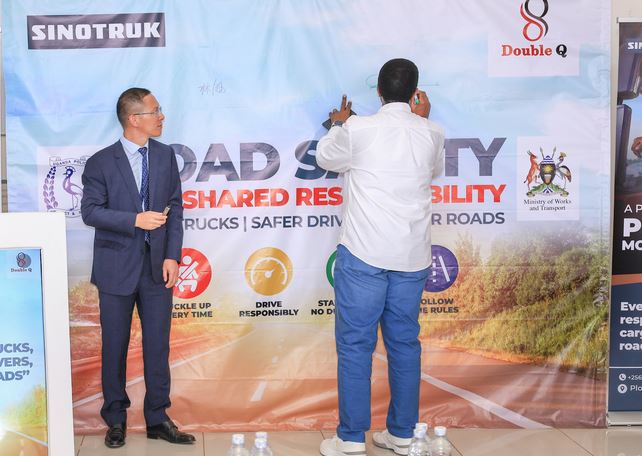
Sinotruk distributor Double Q has launched a nationwide road-safety and customer-support campaign targeting HOWO heavy-duty dump trucks, as concerns over heavy-vehicle accidents and roadworthiness continue to draw attention in Uganda.
“Safer roads require safe vehicles, properly trained drivers, responsible loading, effective maintenance and compliance with road-safety requirements,” he said.
The campaign will run under Double Q’s central message: “Safer Trucks. Safer Drivers. Safer Roads.”
Double Q Managing Director Lin Yu said the company would focus on practical measures and collaboration across the road-transport sector rather than assigning responsibility for crashes to a single party.
“Safety is not simply a responsibility of the driver or the vehicle owner; it is a shared responsibility across the entire road-transport ecosystem,” Lin said.
He said Double Q would strengthen vehicle inspections, customer support, driver awareness and preventive maintenance while working with government agencies, fleet owners, drivers and other stakeholders.
The campaign comes as Uganda grapples with road-safety concerns involving heavy commercial vehicles. Double Q said accidents involving heavy trucks involve multiple factors and that mechanical failure should not automatically be treated as the cause of an individual crash before investigations establish the facts.
As part of the initiative, HOWO dumper owners and fleet operators will be encouraged to subject their vehicles to applicable government road-suitability and roadworthiness assessments. Double Q will offer pre-testing inspections and readiness checks at its after-sales centres in Kampala, Jinja, Hoima, Mbarara, Mbale and Arua .
The checks will focus on critical components including brakes, tyres, steering and suspension systems, lighting, warning systems, tipping and load-body mechanisms and speed governors.
Government has welcomed greater compliance by heavy-vehicle operators. Winstone Katushabe, Commissioner for Transport Regulation and Safety and Chief Licensing Officer, said vehicle owners have a responsibility to maintain roadworthy vehicles and ensure they are operated by appropriately licensed and competent drivers.
“Road safety requires compliance, accountability and cooperation from every stakeholder in the transport sector,” Katushabe said, adding that government would continue working with industry stakeholders to strengthen compliance.
Driver competence is another pillar of the campaign. Double Q plans refresher guidance for approved and licensed dumper drivers, covering defensive driving, braking distances, speed management, blind-spot awareness, reversing, safe loading and load distribution, tipping operations and compliance with road regulations.
The company will also promote routine checks before trucks are deployed, with particular emphasis on brake performance, tyre condition and pressure, steering, suspension, lighting and speed-governor operation.
Richard Musani, Head of Marketing at Double Q, said the company wants to move safety support closer to customers through inspections, driver education, Safety Clinics and after-sales services.
“We want dumper owners, fleet managers and drivers to have practical access to inspections, safety guidance, driver education and after-sales support,” Musani said.
Double Q will establish a dedicated channel for after-sales safety concerns, roadside assistance and escalation of reported problems. Members of the public will also be encouraged to report dangerous driving involving HOWO dumpers, where possible providing the vehicle registration number and location.
The company said reports would be assessed and directed to the relevant vehicle owner or fleet manager and, where necessary, authorities.
Double Q also plans to introduce a HOWO Heavy-Duty Safety Checklist, periodic Safety Clinics and continued customer education in partnership with driver associations, fleet owners, insurers, traffic authorities and other road-safety stakeholders.
The company will measure the campaign through indicators including the number of HOWO dumpers receiving readiness checks, drivers trained, speed governors installed or verified, roadside cases resolved and unsafe-driving reports acted upon.
Lin said the initiative was intended to shift the road-safety discussion toward prevention and shared accountability.
“Safer roads require safe vehicles, properly trained drivers, responsible loading, effective maintenance and compliance with road-safety requirements,” he said.