



Uganda’s ambition to transform into a $500 billion economy by 2040 will not be determined by the size of government spending alone, but by its ability to unlock private capital, improve productivity and build institutions capable of sustaining long-term growth.
That was the dominant message emerging from the 14th CPA Economic Forum, where policymakers, economists and public sector leaders argued that the country’s Tenfold Growth Strategy will succeed only if structural barriers to investment are removed.
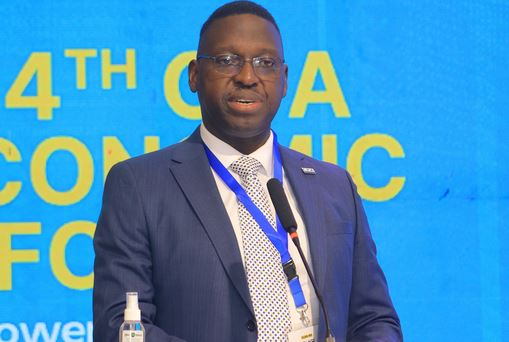
Representing the Ministry of Finance, Planning and Economic Development, Commissioner for Economic Development Policy and Research Joseph Enyimu delivered remarks on behalf of Secretary to the Treasury and Permanent Secretary Ramathan Ggoobi, who emphasised that Uganda must deliberately de-risk its economy to attract significantly higher levels of private investment.
The government’s Tenfold Growth Strategy seeks to expand Uganda’s economy from its current size to approximately $500 billion by 2040, a target that would require sustained high economic growth over nearly two decades.
According to Ggoobi’s message, government must reduce the cost of doing business, improve investor confidence and ensure businesses generate competitive returns on investment if the ambitious target is to become reality.
The emphasis on de-risking reflects a growing recognition that government resources alone cannot finance Uganda’s industrialisation agenda.
Public debt pressures, increasing infrastructure demands and a youthful population mean private sector investment will have to shoulder a much larger share of economic expansion.
Investors, however, continue to weigh concerns over financing costs, regulatory uncertainty, infrastructure bottlenecks and governance risks when making long-term investment decisions.
The forum’s theme, “Powering Uganda’s $500 Billion Future,” captured an important shift in national economic thinking—from focusing primarily on GDP growth to examining the quality and sustainability of that growth.
While Uganda has posted resilient economic performance in recent years, economists increasingly argue that future growth must be driven by higher productivity, value addition, technology adoption and stronger institutions rather than consumption-led expansion alone.
That broader perspective was reinforced by Institute of Certified Public Accountants of Uganda (ICPAU) President Timothy David Ediomu, who argued that economic transformation cannot occur without investing in people’s health.
He urged government to establish a comprehensive national health insurance scheme covering all Ugandans, warning that a productive economy depends on a healthy workforce capable of sustaining higher levels of output.
His remarks highlight an often overlooked dimension of economic policy. Countries that have successfully transitioned into middle-income and high-income economies typically invested heavily in human capital alongside infrastructure.
Better healthcare reduces absenteeism, improves labour productivity and lowers long-term public healthcare costs, making it an economic investment rather than merely a social expenditure.
The discussion also exposed another critical challenge confronting Uganda’s fiscal policy. Economist Pascal Muhangi of the Civil Society Budget Advocacy Group (CSBAG) cautioned that larger government budgets do not automatically translate into better development outcomes.
Instead, he argued that the effectiveness of public expenditure depends on how well resources are planned, allocated and managed.
Muhangi’s observations resonate with longstanding concerns surrounding budget execution in Uganda. Delayed project implementation, procurement inefficiencies, corruption and underutilisation of allocated funds continue to reduce the impact of public investment.
As government seeks to mobilise additional resources to support industrialisation, improving value for money may prove just as important as increasing revenue collection.
The emphasis on accountability is particularly significant as Uganda prepares for major investments linked to oil production, manufacturing, logistics and export diversification.
Without stronger oversight mechanisms, even substantial increases in development financing could produce disappointing economic returns.
Equally important was the focus on public sector capability. George Wafula, Assistant Commissioner for Human Resource Planning and Development at the Ministry of Public Service, argued that economic transformation ultimately depends on building a skilled, adaptive and performance-driven workforce.
He noted that ongoing public service reforms, including digital transformation, performance management and continuous professional development, are intended to strengthen service delivery and improve institutional effectiveness.
This reflects another reality often overshadowed by infrastructure announcements. Roads, industrial parks and energy projects require competent institutions to plan, regulate and manage them efficiently.
Weak administrative capacity can delay investment, discourage businesses and reduce government effectiveness regardless of available financing.
Taken together, the discussions at the CPA Economic Forum revealed broad consensus on what Uganda must do to achieve its ambitious economic target.
The challenge is no longer simply mobilising capital but ensuring that investment flows into a competitive economy supported by efficient public institutions, healthy citizens, skilled workers and accountable governance.
Uganda’s $500 billion economy is therefore not merely a fiscal target but a governance test. Success will depend on whether government can transform policy commitments into measurable improvements in the investment climate while ensuring resources generate tangible economic value.