


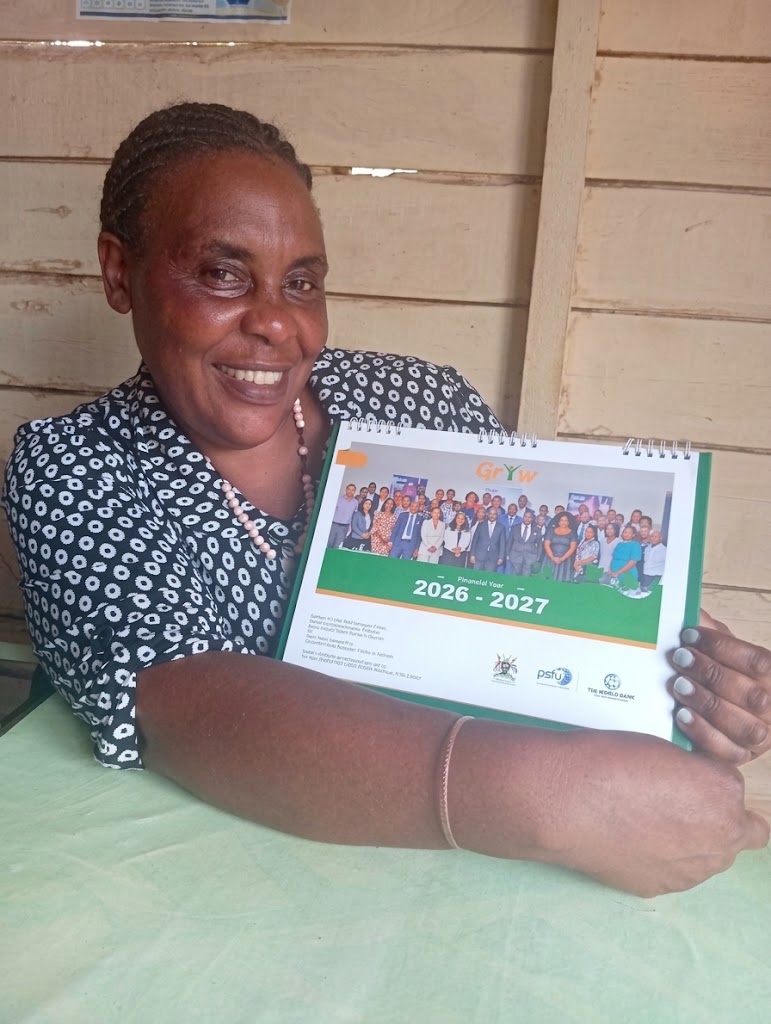
By Brian Mugenyi
A Shs10 million loan is helping Fortunate Turyakera stock more drinks in her Kamwenge business while keeping money flowing into her coffee enterprise, illustrating how targeted credit is turning women-owned microbusinesses into productive assets.
“I want to thank the World Bank for thinking about women and giving us these funds. Our lives and family income earnings changed,” Turyakera said.
Her experience is being repeated across Western Uganda under the Generating Growth Opportunities and Productivity for Women Enterprises (GROW) Project, where women are deploying borrowed capital into retail, restaurants, livestock, agriculture and property.
The project, funded by the World Bank and implemented by the Government of Uganda through the Ministry of Gender, Labour and Social Development in partnership with the Private Sector Foundation Uganda, is designed to address one of the biggest constraints facing women entrepreneurs: access to affordable finance and business-development services.
The numbers show how that capital is moving through the economy.
Christine Muheirwe accessed Shs55 million through UGAFOD Bank to expand a restaurant in Nakivale. The business now employs 12 workers — seven women and five men — turning a single financing transaction into a source of wages and household income.
“As a restaurant, I employ five men and seven women. I pay them and make profit out of the GROW business,” Muheirwe said.
For Arinaitwe Annah, a retailer with about 12 years of experience, Shs10 million has provided additional working capital.
“I want to thank the GROW team leaders and the World Bank for giving us the money at a low interest rate compared to the banks we used to have,” she said.
Other borrowers are directing capital into longer-term assets. Jenifer Twangabe in Kiruhura invested Shs10 million in cattle fattening, goats and poultry, while Edurae Kefuruka used Shs10 million to develop rental property.
The investment logic is straightforward: credit finances inventory and assets, businesses generate sales, workers receive wages, suppliers gain customers and entrepreneurs build capacity to reinvest.
For investors and policymakers, that multiplier is more important than the headline loan value.
GROW is therefore testing whether access to finance, combined with training, mentorship and market support, can help women-owned businesses move beyond survival and into sustained growth.
The risk is equally clear. These are loans, not grants. Borrowers must navigate competition, input costs, demand fluctuations and repayment obligations.
The ultimate measure of the programme will be whether today’s credit produces tomorrow’s stronger businesses, additional jobs, higher incomes and productive assets.
For Western Uganda’s women entrepreneurs, that experiment is already underway.