


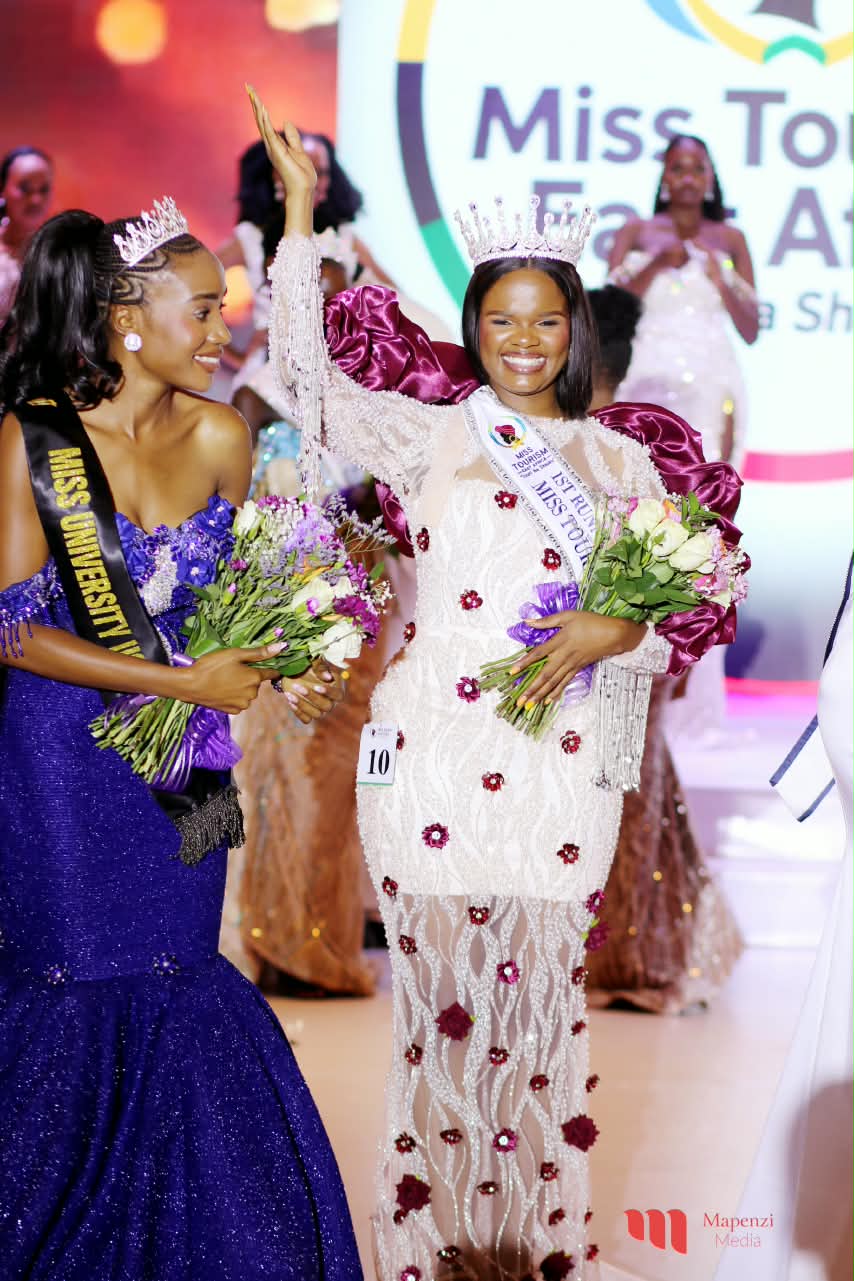
From the cultural heart of Busoga to the regional tourism stage, Uganda’s Miss Tourism East Africa first runner-up is turning a moment of recognition into a platform for change.
By Brian Mugenyi
KAMPALA, UGANDA — For a few seconds, the room held its breath.
Under the bright lights of the Kampala Marriott Hotel, the stage was awash with colour, cameras were trained on the contestants and the anticipation was almost tangible.
Across the room, supporters waited for the announcement that would decide how the evening — and perhaps the next chapter of several young women’s lives — would unfold.
Then came the result.
Zam Zam Godana took the Miss Tourism East Africa crown.
For Shakira Okoobah, there was no crown that night. Instead, there was something that may prove far more enduring: a regional platform, a first-runner-up title and the opportunity to turn visibility into purpose.
For Uganda, and particularly for Busoga, it was still a moment worth celebrating.
Okoobah had carried Uganda’s flag to the regional podium, finishing among a field of young women drawn from across East Africa in a competition where beauty was only one part of the equation. Culture, tourism, confidence, leadership and national identity all shared the stage.
And when the applause eventually settled, one thing became clear: Okoobah was not treating the result as a destination.
She was already thinking about what comes next.
“I shall advocate for change in the community as well as advocating for community environment conservation and the girl child,” she said.
It is a statement that shifts the conversation away from the glitter of pageantry and towards the responsibility that comes with a public platform.
Because a crown, however beautiful, is temporary.
Influence can last much longer.
Okoobah’s journey is rooted in Busoga, a region whose cultural identity has long been woven into Uganda’s wider story. Her rise to the regional tourism stage has therefore carried a meaning beyond the pageant itself.
For many of her supporters, seeing one of their own take her place among East Africa’s finest young ambassadors is a source of pride — and a reminder of the talent emerging from communities far beyond Kampala.
Her appearance on the final night reflected that connection.
Dressed in culturally inspired attire, she brought an unmistakably Ugandan identity to a stage designed to celebrate the diversity of East Africa. Her confidence and composure added to a performance that ultimately placed her among the competition’s leading contestants.
But perhaps the more interesting story begins after the stage lights go out.
What does a young woman do when the cameras stop following her?
What happens when the flowers wilt, the congratulations become fewer and the title becomes yesterday’s news?
For Okoobah, the answer appears to lie in service.
Her decision to champion environmental conservation is particularly relevant to tourism. Uganda’s tourism proposition is built on natural and cultural assets — forests, lakes, wildlife, landscapes, heritage sites and traditional institutions.
Yet the survival of those assets depends on whether communities understand their value and have a stake in protecting them.
That gives Okoobah an opportunity to tell a different tourism story: one in which tourism is not simply about visitors arriving at destinations, but about communities benefiting from the resources around them.
There is also the girl-child agenda.
Across Uganda, thousands of young girls are navigating questions of confidence, education, leadership and opportunity. For some, seeing a young woman from their own country take a regional stage can be powerful in itself.
But inspiration becomes more meaningful when it is followed by action.
Schools could become part of Okoobah’s next journey. So could community engagements, environmental campaigns, mentorship programmes and digital storytelling that places Uganda’s lesser-known tourism destinations in front of wider audiences.
The possibilities are considerable.
The pageant has already given her the microphone.
Now comes the harder task of deciding what to say with it — and, more importantly, what to do with it.
The organisers of the Kampala finale, Masrob Events, created a stage where tourism, culture, beauty and regional identity converged. Among those involved in bringing the event together was Operations Manager Ketty Nabaweesi.
For this writer, the occasion even meant missing a journalism and mass communication lecture ; a small sacrifice for an evening that offered more than spectacle.
It was a window into how cultural platforms can create new forms of visibility for young people and, potentially, new conversations about the societies they represent.
For Okoobah, however, the real test begins now.
Her first-runner-up title gives her visibility. Her connection to Busoga gives her a story. Her advocacy ambitions give her a cause.
The challenge is to bring the three together.
There is a temptation to measure pageant success in crowns, photographs and applause. But the most consequential ambassadors are rarely remembered simply for how they looked beneath the stage lights.
They are remembered for what they built after the lights went off.
Okoobah now has an opportunity to make her regional title mean something beyond the sash.
She can take the story of Busoga to audiences that may never have travelled there. She can use her voice to make environmental conservation part of the tourism conversation. She can stand before young girls and tell them that confidence is not arrogance, that ambition is not something to apologise for and that leadership can begin long before one occupies an office.
That is where her real crown may lie.
On Saturday night, Shakira Okoobah left the Kampala Marriott Hotel as Miss Tourism East Africa’s first runner-up.
She left with a title, a regional platform and a new level of visibility.
But the stage was only the beginning.
The cameras will eventually move on. The applause will fade. The photographs will become memories.
What remains is the work.
And for Okoobah, the question is no longer whether she can command a stage.
She already has.
The more important question is whether she can turn that stage into a movement ;one community, one girl and one conservation story at a time.