




Uganda’s annual headline inflation for the year ending March 2025 dropped to 3.4%, down from previous levels, according to the latest Consumer Price Index (CPI) report released by the Uganda Bureau of Statistics (UBOS).
Similarly, the annual core inflation declined to 3.6%, primarily driven by a slowdown in price increases for services and other goods.
Sam Echoku, the Head of Macro Economic Statistics at UBOS, highlighted that the decline in inflation was influenced by moderated price hikes in key sectors such as passenger transport by road, hotel and lodging services, and essential food items, including rice, fish, matooke, cassava, onions, mangoes, and Irish potatoes.
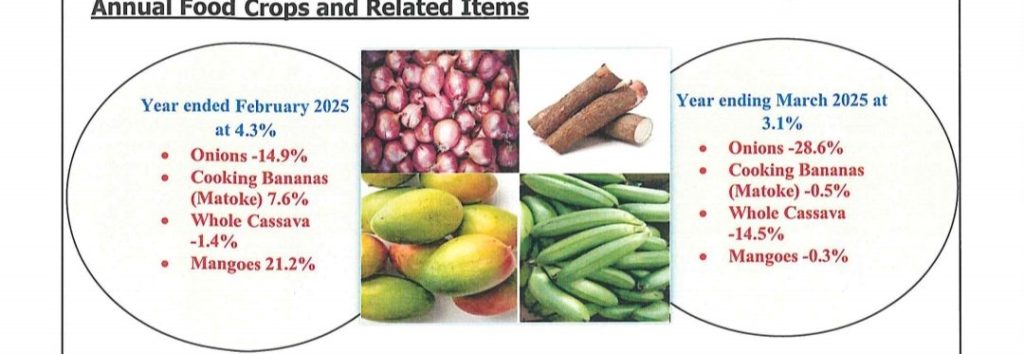
On a monthly basis, the headline inflation registered a decrease of 0.2%, while the core inflation dropped by 0.1%. However, certain commodities experienced price increases during the period, including maize flour, live chicken, refined oil, green pepper, passion fruit, and pineapples. In contrast, firewood and charcoal recorded price reductions, easing household energy costs.
Regional inflation variations were also observed, with Kampala high-income areas registering the highest inflation rate at 4.3%, followed by Masaka at 4.1%. Mbale recorded the lowest inflation rate in the country, standing at 2.0%.
The decline in Uganda’s inflation is a positive sign for the economy, indicating stabilizing consumer prices amid broader economic conditions.