



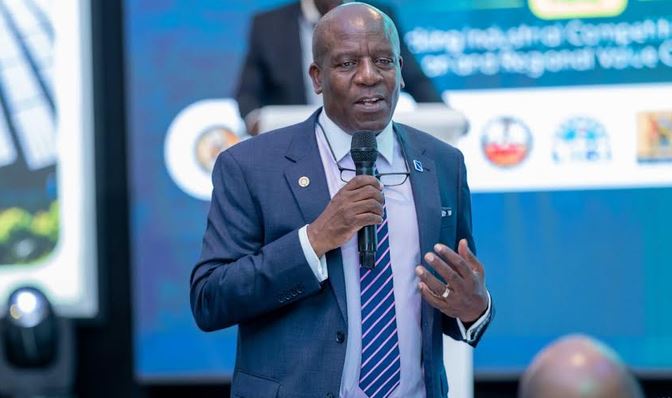
dfcu Bank has called for a fully integrated financial ecosystem across East Africa to unlock capital at scale, strengthen industrial competitiveness and facilitate seamless cross-border trade.
Speaking at the annual Regional Industrialisation Conference convened by the Private Sector Foundation Uganda (PSFU) at Serena Kampala, dfcu Bank Chief Executive Officer Charles Mudiwa said traditional banking models focused primarily on commercial debt were inadequate to finance the region’s industrial transformation.
Mudiwa said East Africa must adopt a broader definition of capital that includes market access, technical expertise and business capabilities needed for enterprises to produce, scale and compete in international markets.
“Capital is far more than cash. Capital is market intelligence, knowing where, how, and when to sell. Capital is also human capability, the technical skills and competencies needed to deliver value,” Mudiwa said.
He said Micro, Small and Medium Enterprises (MSMEs) require a coordinated approach combining technical production skills, financial literacy and patient capital to overcome barriers to growth.
Mudiwa said dfcu Bank has committed 1% of its annual net profits to the dfcu Foundation to establish catalytic funds offering interest-free financing to qualifying enterprises. Beneficiaries repay the principal together with a minimal administration fee, reducing the burden of expensive commercial borrowing.
He cited dfcu’s interventions in agricultural value chains as examples of how targeted financing can de-risk production and support enterprise growth. These include its partnership with Rabobank under the SEED programme to support cocoa farmers in Kasese to transition into commercial chocolate production, as well as school-based poultry initiatives.
According to Mudiwa, the catalytic funding model is designed to help growth-stage businesses expand production, access new markets and eventually transition from local operations to regional and international export markets.
Meanwhile, PSFU Chief Executive Officer Stephen Asiimwe called for stronger government-private sector coordination to turn East African integration commitments into practical improvements in the business environment.
Asiimwe said persistent regulatory and logistical barriers continue to increase the cost of moving goods, services, capital and people across EAC borders.
He warned that delays at borders impose additional transport and financing costs on businesses while limiting access to regional markets, urging governments to prioritise reducing the time and cost of cross-border trade.